




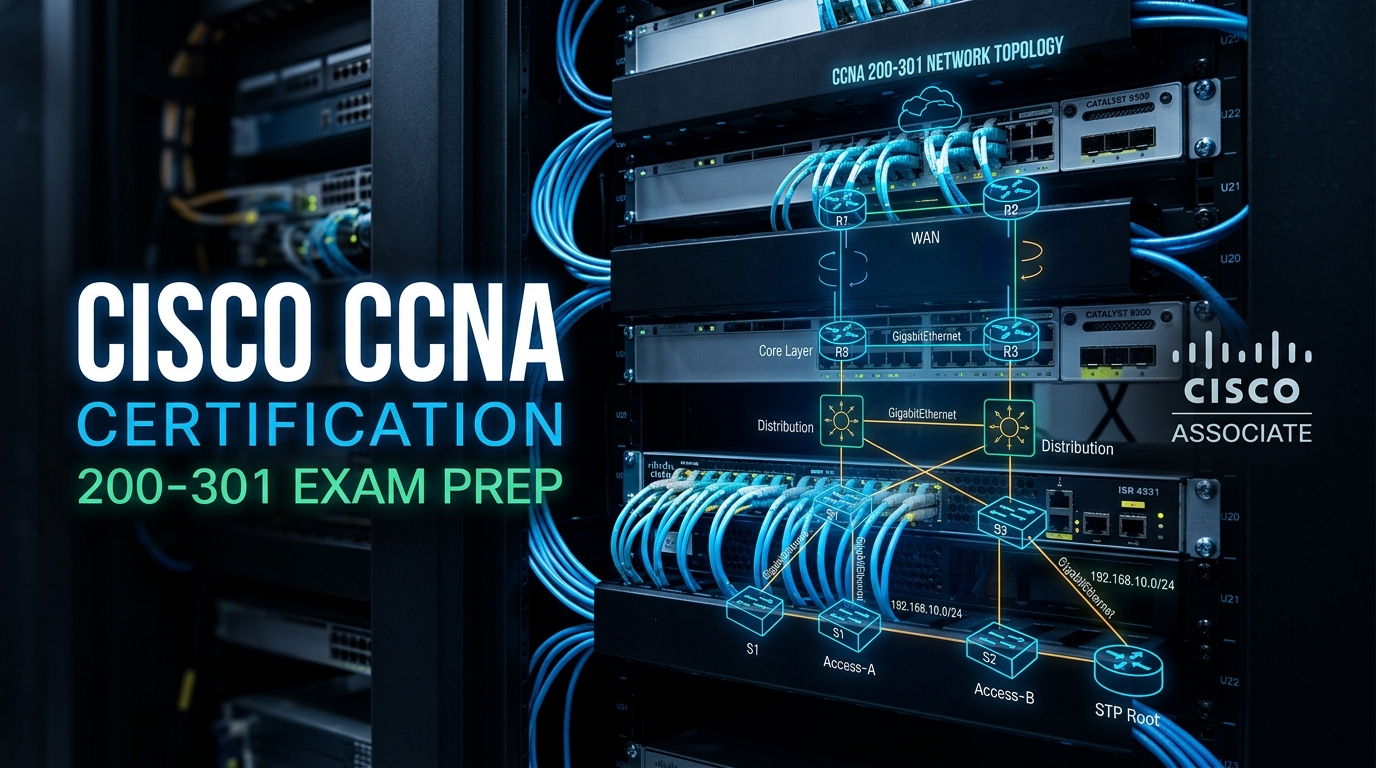
Enterprise Infrastructure
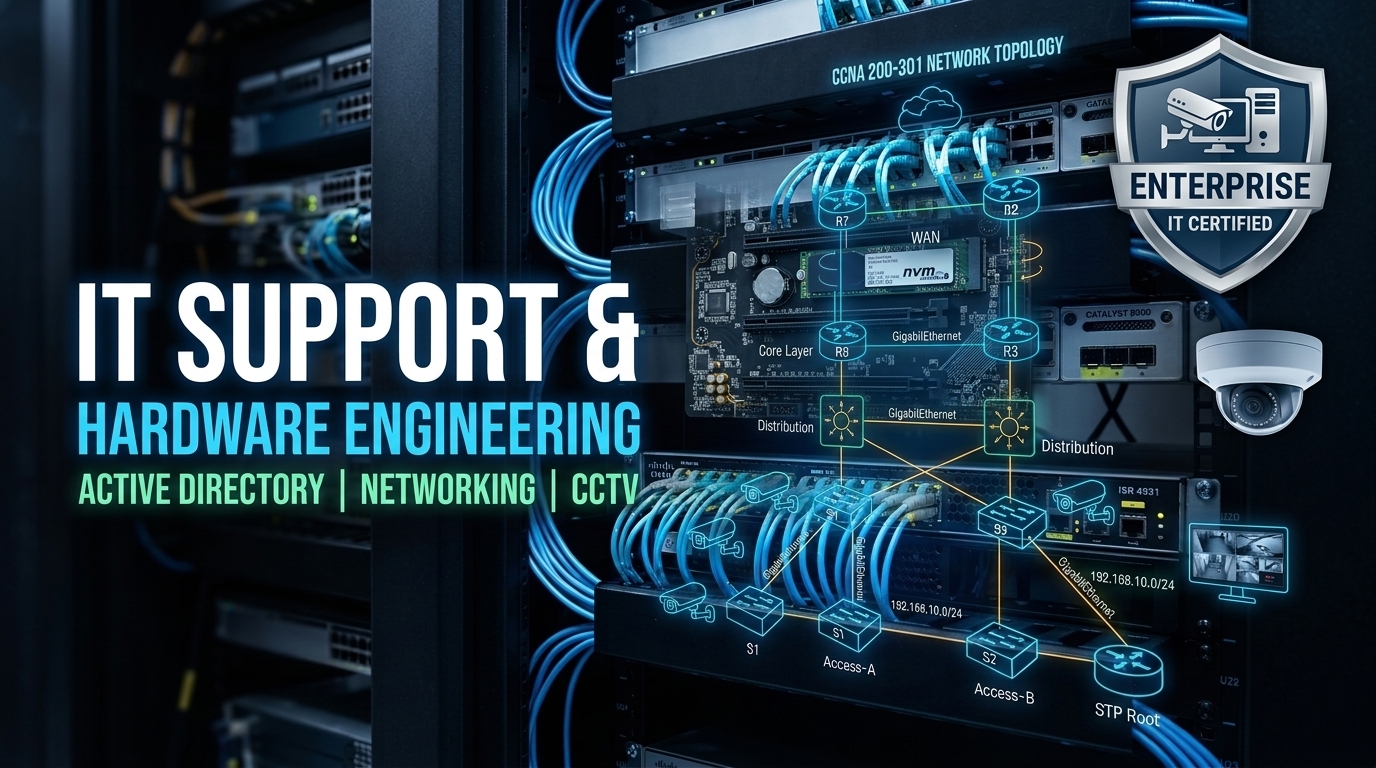
CCNA 200-301 Blueprint
Routing & Switching Fabrics
Network Automation & APIs
In the modern multi-cloud era, enterprise digital connectivity is the foundation of global commerce, automated industrial systems, financial exchanges, and distributed cloud computing. The Cisco Certified Network Associate (CCNA 200-301) certification remains the industry’s premier baseline credential, validating an engineer’s capability to design, configure, secure, and troubleshoot mission-critical enterprise network infrastructure.
Architectural Overview
Exam Code: 200-301 (v1.1)Core Engineering Objectives & First-Attempt Mastery
Unlike surface-level memorization tracks, passing the CCNA 200-301 examination requires deep packet-level comprehension of Layer 2 spanning-tree mechanics, dynamic link-state routing algorithms, packet filtering security policies, and controller-led RESTful automation.
VLAN segmentation, 802.1Q encapsulation, Rapid PVST+ root bridge determinism, and LACP EtherChannel link aggregation.
OSPFv2 single and multi-area convergence, Dijkstra SPF metric calculation, floating static routes, and inter-domain BGP routing.
SDN control plane abstraction, Cisco Catalyst Center telemetry, REST APIs, JSON data serialization, and Python Netmiko automation.
- Enterprise Network Architecture & Core Routing Design
Enterprise campus architectures have evolved from sprawling, flat Layer 2 broadcast domains into highly structured, deterministic multi-tier designs. The standard hierarchical enterprise campus is structured across three distinct physical and logical layers:
01
Core Layer (High-Speed Backbone)
Designed strictly for maximum switching speed and zero packet filtering. The core provides redundant, non-blocking 40GbE/100GbE optical interconnects between campus distribution blocks, data centers, and enterprise WAN edges.
02
Distribution Layer (Policy Boundary)
Acts as the routing and security control boundary. Aggregates access layer switches, performs inter-VLAN routing via Layer 3 Switched Virtual Interfaces (SVIs), enforces QoS marking, and executes security Access Control Lists (ACLs).
03
Access Layer (Endpoint Ingress)
Provides network connection points for end-user workstations, VoIP phones, IP surveillance cameras, and Wi-Fi 6 APs. Enforces edge port security, 802.1X authentication, and DHCP snooping boundaries.
Data Center Evolution: Spine-and-Leaf Fabrics
While campus networks leverage the 3-tier model, modern high-density data centers utilize Spine-and-Leaf (Clos network) topologies. In a 2-tier spine-and-leaf fabric, every leaf switch connects to every spine switch, guaranteeing consistent single-hop latency for high-bandwidth east-west server-to-server traffic flows across the data center.
- IP Addressing, VLSM, and Classless Subnetting Strategies
Accurate address allocation prevents route table bloat, conserves limited public IPv4 address space, and streamlines access control policies. Network engineers must master Variable Length Subnet Masking (VLSM) to allocate subnets proportional to actual host capacity.
| CIDR Prefix | Subnet Mask | Wildcard Mask | Total Addresses | Usable Hosts | Typical Production Use |
|---|---|---|---|---|---|
| /24 | 255.255.255.0 | 0.0.0.255 | 256 | 254 | Standard Departmental Access VLAN |
| /26 | 255.255.255.192 | 0.0.0.63 | 64 | 62 | Branch Office Workgroup Subnet |
| /28 | 255.255.255.240 | 0.0.0.15 | 16 | 14 | Server Farm Management Subnet |
| /30 | 255.255.255.252 | 0.0.0.3 | 4 | 2 | Point-to-Point WAN / Router Interconnect |
| /32 | 255.255.255.255 | 0.0.0.0 | 1 | 1 (Host Route) | Router Loopback ID / Management Address |
- VLAN Segmentation, 802.1Q Trunking & Spanning Tree (RSTP)
Layer 2 switching fabrics isolate physical networks into independent logical broadcast domains using Virtual Local Area Networks (VLANs). When multiple VLANs must traverse switch interconnects, IEEE 802.1Q Trunking injects a 4-byte header tag containing a 12-bit VLAN Identifier (VID), accommodating up to 4,094 unique VLANs.
Rapid PVST+ (IEEE 802.1w) Mechanics
Redundant physical switch uplinks prevent single points of failure but introduce catastrophic Layer 2 broadcast storms and MAC table instability. Rapid Per-VLAN Spanning Tree (Rapid PVST+) converges in sub-seconds by transitioning through three operational states:
- Discarding: Drops data frames and avoids MAC learning.
- Learning: Populates MAC address table without forwarding data.
- Forwarding: Actively forwards Ethernet frames across the fabric.
Edge Protection: PortFast & BPDU Guard
Connecting an end-user host to an STP-enabled access port risks unnecessary 30-second listening/learning delays and spurious Topology Change Notifications (TCNs):
- Spanning-Tree PortFast: Immediately transitions access edge ports into the Forwarding state, eliminating DHCP timeout errors for booting clients.
- BPDU Guard: Automatically places an edge port into the
err-disabledstate if an unauthorized Bridge Protocol Data Unit (BPDU) is received, stopping rogue switch attachments.
- OSPFv2 / OSPFv3, BGP, and Dynamic Routing Topologies
Routers populate their Forwarding Information Base (FIB) by comparing candidate paths using Administrative Distance (AD) and protocol-specific metrics. When multiple routes exist to the identical destination prefix, the router selects the entry with the lowest Administrative Distance:
OSPFv2 Link-State Convergence Mechanics
Open Shortest Path First (OSPF) is an open-standard link-state Interior Gateway Protocol (IGP) powered by Edsger Dijkstra’s Shortest Path First (SPF) algorithm. Unlike distance-vector protocols that route by hearsay, every OSPF router within an area maintains an identical Link-State Database (LSDB) representing the complete network topology map.
Neighbors must agree on identical Area ID, Subnet Mask, Hello/Dead Timers (default 10s/40s on broadcast media), Authentication, and MTU size before progressing from Init → 2-Way → ExStart → Loading → Full State.
On multi-access broadcast networks, OSPF elects a Designated Router (DR) and Backup Designated Router (BDR) based on highest OSPF Interface Priority (0–255), followed by highest Router ID (RID), eliminating $N(N-1)/2$ full-mesh adjacency overhead.
- Network Security: Extended ACLs, NAT/PAT, and Threat Mitigation
A secure infrastructure enforces defense-in-depth across Layer 2 and Layer 3 perimeters. This entails rigorous packet inspection via Extended Access Control Lists (ACLs), traffic translation through Port Address Translation (PAT), and mitigation against spoofing vectors:
Extended Named ACLs
Placed as close to the traffic source as possible. Filters packets based on Source IP, Destination IP, Layer 4 Protocol (TCP, UDP, ICMP), and Port Numbers (e.g., HTTP 80, HTTPS 443, SSH 22). Ends with an implicit deny ip any any rule.
Port Address Translation (PAT)
Maps thousands of RFC 1918 private IPv4 addresses (10.0.0.0/8, 172.16.0.0/12, 192.168.0.0/16) to a single registered public IPv4 address using dynamic 16-bit source port tracking (NAT Overload).
Dynamic ARP Inspection (DAI)
Prevents Man-in-the-Middle (MITM) ARP poisoning attacks. Intercepts all ARP requests and replies on untrusted switchports and validates IP-to-MAC address bindings against the snooping database.
- CCNA 200-301 Engineering Domains & Verification Matrix
This structured matrix cross-references the primary networking domains with their real-world enterprise applications, protocol standards, and critical verification CLI commands required in production troubleshooting:
| Domain & Weight | Key Protocols & Technologies | Enterprise Implementation | Essential CLI Verification |
|---|---|---|---|
| 1.0 Fundamentals (20%) Physical & Logical Foundations | IPv4, IPv6, TCP/UDP, Cat6, Fiber SMF/MMF, Wi-Fi 6 | Enterprise subnet schemas, optical WAN links, campus wireless controller deployments | show interfaces status show ip interface brief |
| 2.0 Network Access (20%) Switching & Trunking Fabric | VLANs, 802.1Q, Rapid PVST+, LACP EtherChannel | Departmental broadcast isolation, root bridge priority determinism, 20Gbps aggregated uplinks | show vlan brief show spanning-tree show etherchannel summary |
| 3.0 IP Connectivity (25%) Core Dynamic Routing | OSPFv2, OSPFv3, Floating Static Routes, eBGP | Multi-area interior dynamic routing, dual-homed ISP failover, Longest Prefix Match path selection | show ip route show ip ospf neighbor show ip ospf database |
| 4.0 IP Services (10%) Infrastructure Management | DHCP Relay, NAT/PAT, NTP, SNMPv3, Syslog, HSRP | Automated host IP leasing across subnets, default gateway first-hop redundancy, centralized log retention | show ip nat translations show standby brief show logging |
| 5.0 Security Fundamentals (15%) Perimeter & Endpoint Hardening | Extended ACLs, Port Security, DHCP Snooping, Dynamic ARP Inspection | Perimeter protocol filtering, rogue DHCP server suppression, ARP spoofing elimination | show access-lists show port-security interface show ip dhcp snooping binding |
| 6.0 Automation & APIs (10%) Programmability & DevNet | Cisco Catalyst Center, REST APIs, JSON, Python, Ansible | Controller-driven software-defined networking (SDN), automated multi-switch configuration deployment | curl -X GET /dna/intent/api python netmiko_push.py |
- Future-Ready Network Automation: Python, REST APIs & Cisco Catalyst Center
The transition from manual Command Line Interface (CLI) box-by-box administration to Software-Defined Networking (SDN) represents the most transformative shift in network engineering. Modern infrastructure relies on centralized controllers that separate the Control Plane (routing logic and path calculations) from the Data Plane (wire-speed ASIC frame forwarding).
Cisco Catalyst Center & RESTful Architecture
Cisco Catalyst Center (formerly DNA Center) acts as the centralized controller for enterprise fabrics. Engineers programmatically query device telemetry, deploy zero-touch provisioning configurations, and enforce micro-segmentation policies using standard RESTful HTTP API calls:
Retrieve Telemetry
Create Resources
Update Configuration
Remove Configuration
import requests
import json

controller_url = "https://catalyst-center.enterprise.local/dna/intent/api/v1/network-device"
headers = {
  "X-Auth-Token": "eyJhbGciOiJIUzI1NiIsInR5cCI6IkpXVCJ9...",
  "Content-Type": "application/json"
}

response = requests.get(controller_url, headers=headers, verify=False)
if response.status_code == 200:
  devices = response.json().get('response', [])
  for device in devices:
      print(f"Device: {device['hostname']} | IP: {device['managementIpAddress']} | Platform: {device['platformId']} | Status: {device['reachabilityStatus']}")
else:
  print(f"HTTP Error {response.status_code}: {response.text}")
Frequently Asked Questions: Technical Concepts & Exam Strategy
- What is the fundamental difference between OSPF and BGP in modern enterprise networks?
OSPF is an Interior Gateway Protocol (IGP) designed for routing within an autonomous system (AS). It uses Dijkstra’s link-state algorithm to optimize for internal speed and metric-based convergence. BGP is an exterior Path-Vector protocol designed to route between disparate Autonomous Systems across the global Internet, making routing decisions based on network policies, path attributes (AS-Path, Local Preference, Multi-Exit Discriminator), and administrative control rather than raw link cost.
- Why does modern Layer 2 design prioritize Rapid PVST+ over legacy 802.1D Spanning Tree?
Legacy 802.1D Spanning Tree relies on passive timer expiration (requiring up to 30 to 50 seconds to transition through Listening and Learning states before forwarding). In contrast, Rapid PVST+ (IEEE 802.1w) uses an active handshake mechanism (proposal/agreement) that achieves deterministic convergence in under 1 second without depending on timers.
- How does Port Address Translation (PAT) handle thousands of internal hosts via one public IP?
Port Address Translation (PAT / NAT Overload) inspects Layer 4 transport headers and maps each unique internal IP and source port combination to a single public IP address paired with a dynamically assigned high-order TCP/UDP port (ranging between 1024 and 65535). The NAT state table tracks these port mappings bi-directionally to ensure return traffic is routed to the exact internal client.
- What automation skills are strictly evaluated on the Cisco CCNA 200-301 examination?
The CCNA blueprint allocates 10% to Automation & Programmability. Candidates are evaluated on comparing traditional vs. controller-based network architectures (Management, Control, and Data planes), interpreting JSON and YAML data formats, recognizing REST API concepts (CRUD operations, HTTP verbs, status codes), and understanding centralized management via Cisco Catalyst Center.
- What is the recommended laboratory strategy to pass CCNA 200-301 on the first attempt?
A robust study approach balances theoretical concept mastery with repetitive hands-on CLI configuration. Utilize Cisco Packet Tracer for foundational protocol behavior and Packet Data Unit (PDU) inspection, followed by EVE-NG or physical Cisco hardware racks to practice multi-area OSPF, EtherChannel negotiation, ACL placement, and troubleshooting misconfigurations under timed exam conditions.