







Primary SEO Metadata
- Target SEO Title: Ethical Hacking: Complete Guide & Roadmap to Cybersecurity
- Meta Description: Master ethical hacking and cybersecurity. Learn the 5 penetration testing phases, essential tools, OWASP Top 10 vulnerabilities, and career certification paths.
- Primary Keyword: Ethical Hacking
- Secondary / LSI Keywords: cybersecurity, certified ethical hacker (CEH), penetration testing, types of hackers (white hat vs black hat vs grey hat), ethical hacking phases (reconnaissance, scanning, gaining access, maintaining access, clearing tracks), ethical hacking tools (Kali Linux, Nmap, Metasploit, Wireshark, Burp Suite), vulnerability assessment, web application security (OWASP Top 10), network security, ethical hacking roadmap/career path, cyber laws and legal compliance.
- Search Intent: Informational + Practical Technical Masterclass (Beginner to Advanced)
Ethical Hacking & Cybersecurity: The Definitive Enterprise Masterclass and Career Roadmap
+----------------------------------------------------------------------------------------------------+
|                         ENTERPRISE INFORMATION SECURITY & DEFENSIVE POSTURE                        |
+------------------------------------+-----------------------------------+---------------------------+
| CONFIDENTIALITY (Data Privacy)     | INTEGRITY (Data Trustworthiness)  | AVAILABILITY (Uptime)     |
| - AES-256-GCM / ChaCha20 At-Rest   | - SHA-256 / SHA-3 Hash Telemetry  | - DDoS Mitigation & BGP   |
| - TLS 1.3 In-Transit Ciphers       | - Digital Signatures & HMAC Checks| - Redundant Clusters / HA |
| - Zero-Trust Role-Based Access     | - Immutable Write-Once Audit Logs | - Disaster Recovery / BCP |
+------------------------------------+-----------------------------------+---------------------------+
1. Introduction to Ethical Hacking
In the hyper-connected architecture of modern enterprise operations, digital infrastructure is under constant, automated siege. Millions of unauthorized access attempts, automated vulnerability scanners, and sophisticated targeted intrusions occur globally every hour. In this threat climate, organizations can no longer rely on perimeter firewalls and antivirus software alone. Security requires proactive discovery: systems must be rigorously probed, attacked, and verified by security professionals using the exact methodologies employed by threat actors. This practice is Ethical Hacking.
1.1 Defining Ethical Hacking vs. Malicious Cybercrime
The fundamental distinction between Ethical Hacking (often synonymous with professional Penetration Testing) and Malicious Hacking (cybercrime) does not lie in the toolkits, operating systems, or exploit payloads utilized. Both disciplines leverage network sniffers, memory corruption exploits, port scanners, and reverse engineering frameworks. The divergence rests entirely upon three non-negotiable legal and operational pillars:
- Explicit Authorization: An ethical hacker operates exclusively under explicit, legally binding written authorization from the system’s legal asset owner. Without an authorized Scope of Work (SOW) and Rules of Engagement (RoE), any probe into an IP address or web server is legally treated as an attempted intrusion under national and international cybercrime legislation.
- Defensive Intent: The objective of an ethical hacker is to unearth system weaknesses, misconfigurations, and software vulnerabilities for the sole purpose of reporting, remediating, and hardening those assets before malicious actors exploit them.
- Integrity and Non-Disruption: Ethical hackers adhere to strict operational constraints to preserve data integrity, protect sensitive user information, and prevent disruption of critical enterprise services.
1.2 Why Modern Organizations Need Ethical Hackers
The explosion of distributed microservices, multi-cloud computing environments (AWS, Azure, Google Cloud), Software-as-a-Service (SaaS) platforms, and remote enterprise endpoints has expanded the corporate attack surface beyond traditional network boundaries. Organizations face compounding pressures:
- Severe Financial and Regulatory Penalties: Data breaches cost enterprises millions of dollars in forensic recovery, direct business downtime, and severe regulatory fines under frameworks such as GDPR, HIPAA, and PCI-DSS.
- Ransomware Extortion: Modern ransomware syndicates weaponize zero-day vulnerabilities, exfiltrate confidential intellectual property, and encrypt operational databases, demanding millions in ransom while threatening public disclosure.
- Reputational and Brand Destruction: A compromised customer database immediately shatters market credibility, erodes consumer trust, and tanks public enterprise valuation.
Ethical hacking transforms an organization’s defensive posture from reactive crisis management into proactive resilience engineering.
1.3 The Core Foundational Principle: The CIA Triad
Every security audit, penetration test, and defensive implementation evaluates systems against three foundational tenets known as the CIA Triad:
                 [ CONFIDENTIALITY ]
                    /          \
                   /   SECURITY \
                  /   ASSURANCE  \
      [ INTEGRITY ] ------------- [ AVAILABILITY ]
- Confidentiality: Ensuring that sensitive enterprise data, authentication credentials, and proprietary assets are shielded from unauthorized discovery. Breaches occur through SQL injection, packet eavesdropping, insecure direct object references (IDOR), and credential stuffing.
- Integrity: Guaranteeing the absolute accuracy, completeness, and tamper-resistance of data across its lifecycle. Threat actors compromise integrity by intercepting unencrypted sessions, executing Man-in-the-Middle (MITM) modifications, altering database records, or poisoning DNS caches.
- Availability: Ensuring critical computational infrastructure, network conduits, and application platforms remain consistently accessible to authorized users. Threats include Distributed Denial-of-Service (DDoS) volumetric floods, database resource exhaustion, and destructive wiper malware.
2. Types of Hackers: Understanding the Threat Spectrum
The information security domain categorizes actors across a behavioral, ethical, and legal spectrum. Understanding these classifications is essential for analyzing threat motives, tactics, techniques, and procedures (TTPs).
+--------------------------------------------------------------------------------------------------------+
|                                  THE HACKER SPECTRUM & MOTIVATION MATRIX                               |
+--------------------+-----------------------------+---------------------------+-------------------------+
| Category           | Authorization & Legality    | Primary Motivations       | Enterprise Impact       |
+--------------------+-----------------------------+---------------------------+-------------------------+
| White Hat          | Full Written Authorization  | Defense, Hardening, Audit | Heightened Security &   |
| (Ethical Hacker)   | 100% Legal & Compliant      | Vulnerability Discovery   | Threat Prevention       |
+--------------------+-----------------------------+---------------------------+-------------------------+
| Black Hat          | Unauthorized & Malicious    | Financial Extortion, Data | Data Loss, Ransomware,  |
| (Threat Actor)     | Illegal Under All Laws      | Theft, Espionage, Sabotage| Destruction of Uptime   |
+--------------------+-----------------------------+---------------------------+-------------------------+
| Grey Hat           | Unauthorized But Often      | Curiosity, Ego, Bounty    | Uncontrolled Disclosure,|
| (Boundary Tester)  | Non-Malicious Intent        | Seeking, Recognition      | Unregulated Risk        |
+--------------------+-----------------------------+---------------------------+-------------------------+
| Script Kiddie      | Unauthorized / Unskilled    | Notoriety, Thrills,       | Noise, Service Floods,  |
| (Amateur Actor)    | Illegal                     | Copycat Disruption        | Low-Complexity Breaches |
+--------------------+-----------------------------+---------------------------+-------------------------+
| Hacktivist         | Unauthorized Target Abuse   | Political Ideology,       | Public Defacement, DDoS,|
| (Ideological Actor)| Illegal                     | Social Agendas, Activism  | Confidential Leaks      |
+--------------------+-----------------------------+---------------------------+-------------------------+
| State-Sponsored    | Sanctioned by Nation-States | Geopolitical Advantage,   | Critical Infrastructure |
| (APT Syndicates)   | Extreme Espionage Threat    | Defense Sabotage, Warfare | Compromise, Espionage   |
+--------------------+-----------------------------+---------------------------+-------------------------+
2.1 White Hat Hackers (Ethical Hackers / Security Researchers)
White Hat hackers leverage their security expertise within strict legal boundaries. Retained as internal Red Team operators, external Penetration Testers, or participating in authorized Bug Bounty platforms (such as HackerOne or Bugcrowd), they discover weaknesses, validate potential exploit paths, and provide actionable remediation guides before criminal actors can strike.
2.2 Black Hat Hackers (Cybercriminals / Threat Actors)
Black Hat hackers operate outside the law. Their primary drivers include illicit financial extraction (ransomware operations, payment card theft), corporate espionage, intellectual property theft, and infrastructure disruption. They develop custom malware, deploy rootkits, maintain underground botnets, and sell exfiltrated databases on darknet forums.
2.3 Grey Hat Hackers
Grey Hat hackers inhabit an ethical middle ground. They routinely identify vulnerabilities in public infrastructure or corporate websites without prior authorization. While they rarely inject malicious payloads or intentionally damage data, they violate legal standards by probing systems without an explicit contract. They often contact system owners privately to request a bounty or publicly disclose the vulnerability if ignored, forcing an uncoordinated patch.
2.4 Script Kiddies, Hacktivists, and Advanced Persistent Threats (APTs)
- Script Kiddies: Novice individuals lacking foundational understanding of networking, operating system internals, or exploit mechanics. They download pre-compiled point-and-click tools, LOIC (Low Orbit Ion Cannon), or automated scripts to execute noisy denial-of-service floods or defacements.
- Hacktivists: Collectives motivated by socio-political, environmental, or ideological causes. Their operations typically involve website defacement, distributed denial-of-service campaigns, and public document leaks to draw international media attention to specific geopolitical grievances.
- State-Sponsored Actors (APTs): Highly funded, militarily organized cyber intelligence agencies (Advanced Persistent Threats). APTs operate stealthily over months or years, leveraging custom zero-day exploits to breach defense networks, national power grids, telecommunication hubs, and government agencies.
3. The 5 Crucial Phases of Ethical Hacking
Professional penetration testing adheres to standard testing methodologies, such as the Penetration Testing Execution Standard (PTES) and the NIST SP 800-115 technical assessment guidelines. A penetration test follows a five-phase lifecycle:
[ Phase 1: Reconnaissance ]
             |
             v
[ Phase 2: Scanning & Enumeration ]
             |
             v
[ Phase 3: Gaining Access (Exploitation) ]
             |
             v
[ Phase 4: Maintaining Access (Persistence & Pivoting) ]
             |
             v
[ Phase 5: Clearing Tracks & Reporting ]
Phase 1: Reconnaissance & Information Gathering
Reconnaissance is the initial phase where an ethical hacker gathers intelligence on the target organization. Up to 70% of penetration testing effort is spent in this phase.
- Passive Reconnaissance (Open-Source Intelligence - OSINT): Interrogating publicly available resources without interacting directly with the target’s network infrastructure.
- WHOIS Records & Registrars: Identifying domain ownership, registrar information, registration dates, and technical administrative contacts.
- DNS Reconnaissance: Querying publicly reachable DNS servers for
A,AAAA,MX,TXT(SPF/DKIM),CNAME, andNSrecords using utilities likedigandhost. - Search Engine Footprinting (Google Dorking): Utilizing search operators to discover exposed credentials, open configuration files, and indexed staging portals:
site:target.com filetype:env "DB_PASSWORD" site:target.com inurl:admin | inurl:login site:target.com intitle:"index of /" - Internet-of-Things & Attack Surface Engines: Querying platforms like Shodan and Censys to identify target-owned IP space, public services, expired TLS certificates, and open ports without sending a single probe from the tester’s IP.
- Active Reconnaissance: Directly probing target boundaries. Because active probing generates connection logs on edge firewalls and Intrusion Detection Systems (IDS), it is conducted strictly within the authorized scope of engagement.
Phase 2: Scanning & Enumeration
Once the active IP boundaries, hostnames, and domain scopes are established, the ethical hacker moves to scanning and enumeration. The goal is to uncover running services, daemon versions, and accessible architectural entrypoints.
- Network & Port Discovery: Identifying which of the 65,535 TCP/UDP ports are open, closed, or filtered.
- TCP SYN Stealth Scanning (
-sS): Sends an initialSYNpacket; if the target responds withSYN/ACK, the port is marked open, and aRSTis immediately returned to tear down the socket before the three-way handshake completes. This reduces application-layer logging.
- TCP SYN Stealth Scanning (
- Service Version & Banner Grabbing: Interrogating open sockets to extract application daemon banners (e.g.,
Apache 2.4.49,OpenSSH 8.2p1,Microsoft-IIS/10.0), identifying vulnerable or outdated software builds. - Vulnerability Scanning: Automated scanners (e.g., Tenable Nessus, OpenVAS) evaluate service versions against established Common Vulnerabilities and Exposures (CVE) databases to flag known vulnerabilities.
- Deep Service Enumeration: Querying open network services for internal architecture details:
- SMB Enumeration: Interrogating Port 445 for unauthenticated guest shares, open IPC$ pipes, and domain user accounts.
- SNMP Walking: Querying UDP Port 161 using common community strings (
public,private) to pull routing tables, network interface metrics, and running software processes. - Web Directory & Content Fuzzing: Bruteforcing hidden web paths using wordlists to discover forgotten administrative endpoints:
gobuster dir -u https://target.com -w /usr/share/wordlists/dirb/common.txt -x php,html,js,txt -t 30
Phase 3: Gaining Access (Exploitation)
In this phase, the ethical hacker transitions from analytical scanning to active exploitation, validating whether identified vulnerabilities can be leveraged to gain unauthorized execution or access.
- Network-Level Exploitation: Targeting unpatched network daemon services, remote buffer overflows, or authentication bypass flaws using exploit frameworks like Metasploit.
- Web Application Exploitation: Bypassing authentication gates, attacking flawed input validation channels, injecting malicious commands into backend database engines (SQLi), or hijacking client sessions via Cross-Site Scripting (XSS).
- Client-Side & Social Engineering Exploitation: Delivering targeted phishing scenarios, trojanized macro-enabled documents, or rogue payload USBs in physical assessment scenarios to execute initial reverse shells inside the internal network.
- Payload Engineering:
- Bind Shells: The exploit payload opens a listening TCP port directly on the compromised victim machine, waiting for the tester to connect. (Often blocked by inbound edge firewall rules).
- Reverse Shells: The exploit payload forces the compromised victim machine to initiate an outbound TCP/HTTPS connection back to the tester’s listening control server (
nc -lvnp 4444). This reliably bypasses restrictive inbound firewall rules.
Phase 4: Maintaining Access (Persistence & Pivoting)
Gaining an initial, unprivileged shell is rarely the end goal of a penetration test. Phase 4 evaluates whether an attacker can sustain their foothold across system reboots, elevate privileges, and navigate deeper into internal subnets.
- Privilege Escalation:
- Linux Privilege Escalation: Exploiting binaries with the SetUID (SUID) permission bit set, abusing permissive
sudoersconfigurations (sudo -l), cracking credentials stored in unshadowed password files, or exploiting kernel vulnerabilities (e.g., Dirty COW, Dirty Pipe). - Windows Active Directory Escalation: Extracting cached hashes using Mimikatz, exploiting unquoted service paths, abusing weak service permissions, and conducting Kerberoasting to crack service ticket hashes offline.
- Linux Privilege Escalation: Exploiting binaries with the SetUID (SUID) permission bit set, abusing permissive
- Persistence Mechanisms: Installing persistent hooks that survive machine reboots: creating backdoor administrative user accounts, deploying scheduled cron jobs, configuring systemd services, or setting Windows Registry run keys (
HKCU\Software\Microsoft\Windows\CurrentVersion\Run). - Pivoting & Lateral Movement: Using a dual-homed compromised host (e.g., a web server connected to both the public DMZ and internal corporate LAN) as a springboard. By deploying encrypted proxy tunnels (SSH dynamic port forwarding
-D, Chisel, or SOCKS5 proxies), the tester routes attack tools deep into isolated internal subnets.
Phase 5: Clearing Tracks & Professional Reporting
The final phase distinguishes professional ethical hackers from threat actors.
+---------------------------------------------------------------------------------------------------+
|                        ANATOMY OF AN ENTERPRISE PENETRATION TESTING DELIVERABLE                   |
+------------------------------------+--------------------------------------------------------------+
| 1. Executive Summary               | High-level risk assessment, business impact analysis, and    |
|                                    | strategic investment priorities designed for C-level readers.|
+------------------------------------+--------------------------------------------------------------+
| 2. Methodology & Scope Metrics     | Comprehensive audit boundaries, IP blocks tested, RoE rules,  |
|                                    | test limitations, and timeline of simulated engagements.     |
+------------------------------------+--------------------------------------------------------------+
| 3. Technical Findings by CVSS      | Detailed breakdowns: CVE identifiers, CVSS v3.1 base scores,  |
|                                    | exploit descriptions, and affected enterprise hosts.         |
+------------------------------------+--------------------------------------------------------------+
| 4. Proof-of-Concept (PoC) Steps    | Reproducible, step-by-step instructions showing how access   |
|                                    | was gained, validating the risk for engineering teams.       |
+------------------------------------+--------------------------------------------------------------+
| 5. Actionable Remediation Guidance | Precise code patches, configuration changes, network rules,   |
|                                    | and operational safeguards required to neutralize the threat.|
+------------------------------------+--------------------------------------------------------------+
- Covering Tracks (Awareness vs. Action): While malicious attackers purge event logs (
wevtutil cl System, wiping/var/log/auth.log) and deploy rootkits to hide processes, an ethical hacker does not maliciously erase forensic history. Instead, the ethical hacker documents what footprints were generated and methodically removes all uploaded test artifacts, temporary scripts, user test accounts, and backdoor persistence hooks. - Delivering the Final Report: The ultimate value of an ethical hacking engagement is the technical report. It provides an executive summary for executive leadership alongside detailed technical vulnerability descriptions, reproducible step-by-step proofs of concept, CVSS v3.1 severity scores, and engineering-level remediation plans.
4. Top Essential Tools Used by Ethical Hackers
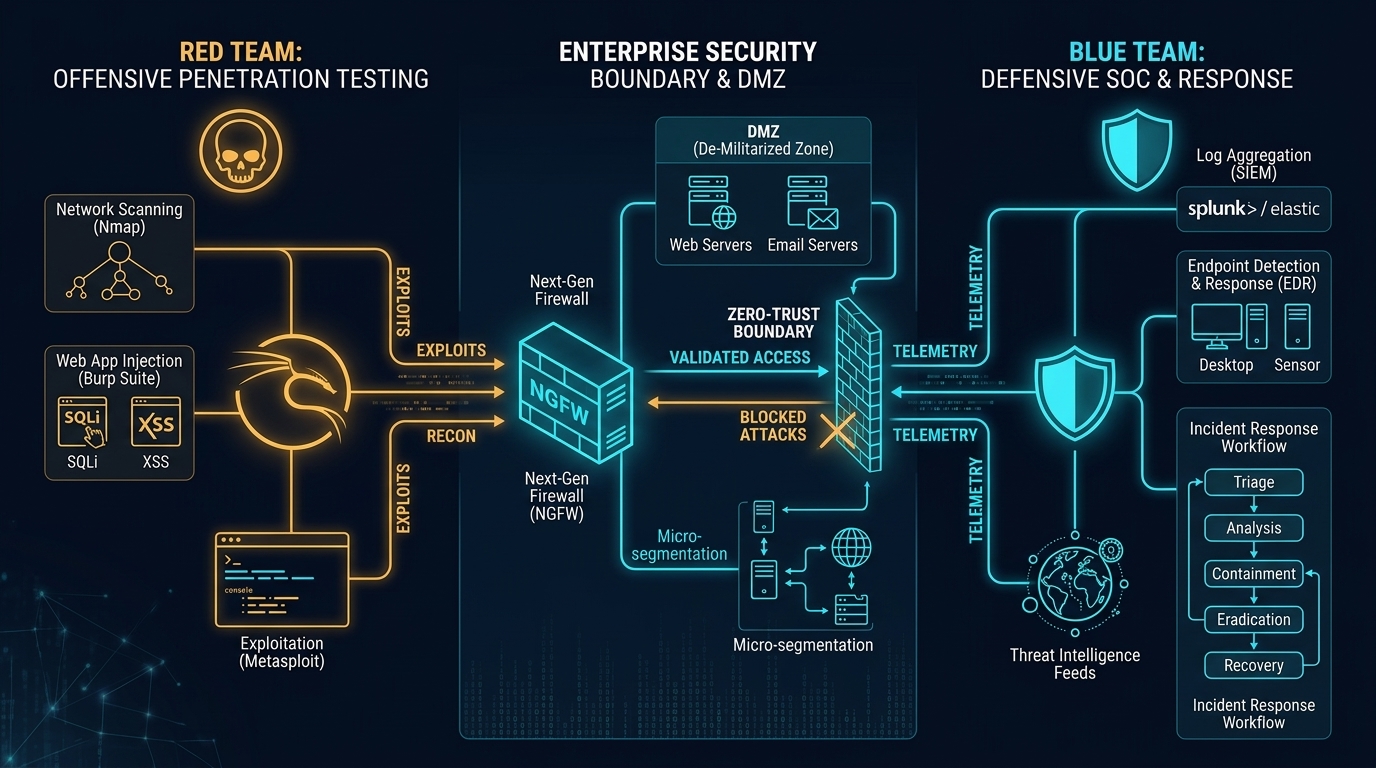
Ethical hackers leverage an arsenal of specialized tools across operating systems, network scanners, exploit frameworks, web proxies, and packet analyzers.
+------------------------------------------------------------------------------------------------------+
|                               ESSENTIAL TOOLKIT FOR PROFESSIONAL ETHICAL HACKERS                     |
+----------------------+--------------------+----------------------------------------------------------+
| Category             | Primary Tool       | Core Purpose & Key Command / Capability                  |
+----------------------+--------------------+----------------------------------------------------------+
| Operating System     | Kali Linux         | Specialized Debian distro loaded with 600+ tools:        |
|                      |                    | `sudo apt update && sudo apt install kali-tools-top10`   |
+----------------------+--------------------+----------------------------------------------------------+
| Network Scanning &   | Nmap               | TCP/UDP port scanner, OS detection, service versioning:  |
| Host Discovery       |                    | `nmap -sS -sV -sC -p- -T4 -oA target-scan 10.10.10.5`    |
+----------------------+--------------------+----------------------------------------------------------+
| Vulnerability &      | Metasploit         | Modular exploit execution, payload generator (msfvenom): |
| Exploitation Engine  | Framework          | `msfconsole -q; use exploit/multi/handler; set PAYLOAD`  |
+----------------------+--------------------+----------------------------------------------------------+
| Automated VAPT       | Tenable Nessus     | Enterprise policy compliance, configuration flaw checks, |
| Scanner              |                    | network-wide CVE vulnerability identification & audits   |
+----------------------+--------------------+----------------------------------------------------------+
| Web App Interception | Burp Suite         | HTTP/S proxy, request repeater, parameter intruder,      |
| & Proxy Engine       | Professional       | automated OWASP vulnerability scanner & API analysis     |
+----------------------+--------------------+----------------------------------------------------------+
| Network Sniffing &   | Wireshark          | Raw promiscuous packet capture, protocol decoding:       |
| Packet Analysis      |                    | Filter: `tcp.port == 80 && http.request.method == "POST"`|
+----------------------+--------------------+----------------------------------------------------------+
| Password Cracking &  | Hashcat &          | High-speed GPU hash cracking and online service brute    |
| Authentication Audit | John the Ripper    | forcing: `hashcat -m 1000 -a 0 ntlm.hashes rockyou.txt`  |
+----------------------+--------------------+----------------------------------------------------------+
4.1 Operating System: Kali Linux & Parrot Security OS
- Kali Linux: Maintained by Offensive Security, Kali is the industry-standard distribution for penetration testing and digital forensics. Built upon Debian, it comes pre-packaged with over 600 penetration testing tools, specialized kernels patched for wireless packet injection, and support across x86, ARM, and containerized deployments.
- Parrot Security OS: An alternative Debian-based distribution emphasizing lightweight resource consumption, development utilities, and built-in privacy protection (e.g., AnonSurf).
4.2 Network Discovery: Nmap (Network Mapper)
Nmap is the gold standard for network inventory, port scanning, and vulnerability detection. It provides granular raw-packet control:
# Production-grade TCP SYN reconnaissance scan:
# -sS: Stealth SYN scan
# -sV: Probe open ports to determine service/version info
# -sC: Run default safe Nmap NSE scripts
# -p-: Scan all 65,535 ports
# -T4: Aggressive timing template for faster completion
# -oA: Output scan results in three major formats (Nmap, Grepable, XML)
nmap -sS -sV -sC -p- -T4 -oA enterprise_audit 192.168.1.100
4.3 Exploitation Framework: Metasploit Framework
Maintained by Rapid7, Metasploit is the world’s most widely deployed exploitation engine. It separates vulnerability research into modular components: exploits (software targeting a vulnerability), payloads (code executing on the victim post-compromise), encoders (obfuscating signatures), and auxiliary modules (scanners, fuzzers, and sniffers).
# Launching Metasploit and preparing a listener
msfconsole -q
msf6 > use exploit/multi/handler
msf6 exploit(multi/handler) > set PAYLOAD windows/x64/meterpreter/reverse_tcp
msf6 exploit(multi/handler) > set LHOST 10.10.14.5
msf6 exploit(multi/handler) > set LPORT 4444
msf6 exploit(multi/handler) > exploit -j
4.4 Web Application Security: Burp Suite & OWASP ZAP
- Burp Suite (PortSwigger): An essential platform for web application and API security assessments. Burp functions as an inline proxy between the web browser and the target server, allowing the tester to intercept, inspect, decode, alter, and replay raw HTTP/S headers, cookies, and JSON/XML payloads. Key components include the Proxy, Repeater (manual parameter testing), Intruder (customized fuzzing), and Decoder.
- OWASP ZAP (Zed Attack Proxy): An open-source, community-driven web application scanner widely used in DevSecOps pipelines for automated vulnerability detection during continuous integration workflows.
4.5 Packet Analysis: Wireshark
Wireshark is an advanced packet capture and deep network inspection utility. Operating in promiscuous mode, it decodes hundreds of network protocols in real time:
# Useful Display Filters in Wireshark:
# Isolating unencrypted authentication submissions:
http.request.method == "POST" && http contains "password"

# Detecting ARP spoofing / poisoning attempts:
arp.duplicate-address-detected || arp.opcode == 2

# Tracing all communications with a specific IP:
ip.addr == 192.168.1.50 && tcp.flags.reset == 1
5. Web Application Security & Common Vulnerabilities
Web applications represent the primary external exposure point for modern enterprises. The Open Web Application Security Project (OWASP) publishes the OWASP Top 10, an internationally recognized standard reflecting the most critical web application security risks.
+----------------------------------------------------------------------------------------------------+
|                                    OWASP TOP 10 CORE VECTORS AT A GLANCE                           |
+----------------------------+-----------------------------------+-----------------------------------+
| Vulnerability Class        | Root Operational Cause            | Remediation Strategy              |
+----------------------------+-----------------------------------+-----------------------------------+
| A01: Broken Access Control | Missing authorization checks,     | Centralized server-side role and  |
|                            | IDOR parameter tampering          | object ownership verification     |
+----------------------------+-----------------------------------+-----------------------------------+
| A02: Cryptographic Failures| Cleartext protocols, outdated     | Enforce TLS 1.3, AES-256-GCM,     |
|                            | ciphers (MD5), missing salting    | strong key derivation (Argon2id)  |
+----------------------------+-----------------------------------+-----------------------------------+
| A03: Injection             | Direct interpolation of untrusted | Parameterized Prepared Statements,|
| (SQLi, Command Injection)  | user input into interpreter engines| strict whitelist input validation |
+----------------------------+-----------------------------------+-----------------------------------+
| A05: Security              | Default credentials, verbose debug| Hardened baseline configurations, |
| Misconfiguration           | stack traces, open cloud buckets  | disable unused features and ports |
+----------------------------+-----------------------------------+-----------------------------------+
| A07: Identification and    | Missing MFA, weak password rules, | Implement mandatory MFA, session  |
| Authentication Failures    | predictable session tokens        | rotation, rate limiting on login  |
+----------------------------+-----------------------------------+-----------------------------------+
5.1 SQL Injection (SQLi)
SQL Injection occurs when untrusted user input is directly concatenated into a dynamic SQL database query string without proper sanitization or parameterization, allowing an attacker to manipulate the underlying database query logic.
+--------------------------------------------------------------------------------------------+
|                            ANATOMY OF A CLASSIC SQL INJECTION ATTACK                       |
+--------------------------------------------------------------------------------------------+
|                                                                                            |
|   1. Attacker submits crafted input:   ' OR '1'='1' --                                     |
|                                                                                            |
|   2. Flawed Application Query:                                                             |
|      SELECT * FROM users WHERE username = '' OR '1'='1' --' AND password = '...'           |
|                                                                                            |
|   3. Database Evaluates:                                                                   |
|      The statement '1'='1' evaluates to TRUE; everything after '--' is treated as comment. |
|                                                                                            |
|   4. Impact: The query returns all records, bypassing authentication entirely!             |
+--------------------------------------------------------------------------------------------+
- Vulnerable Implementation (Dynamic String Concatenation):
// DANGEROUS: Untrusted user input is concatenated directly into SQL command $user = $_POST['username']; $pass = $_POST['password']; $query = "SELECT * FROM accounts WHERE username = '" . $user . "' AND password = '" . $pass . "'"; $result = mysqli_query($conn, $query); - Secure Remediation (Parameterized Prepared Statements):
// SECURE: Database engine treats input strictly as data, never executable SQL commands
$stmt = $pdo->prepare('SELECT id, password_hash, role FROM accounts WHERE username = :username');
$stmt->execute(['username' => $_POST['username']]);
$user = $stmt->fetch();

if ($user && password_verify($_POST['password'], $user['password_hash'])) {
    // Authentication granted under secure session handling
}
5.2 Cross-Site Scripting (XSS)
Cross-Site Scripting occurs when an application includes untrusted user data in a rendered web page without appropriate contextual encoding or sanitization, allowing an attacker to execute arbitrary JavaScript inside a victim’s browser session.
- Stored XSS (Persistent): Malicious JavaScript is permanently stored in the target database (e.g., in a comment field or profile bio). Every user viewing that record executes the payload, enabling automated session hijacking and worm propagation.
- Reflected XSS (Non-Persistent): The malicious script is reflected off the web server via a query parameter or search form submission, executing when a victim clicks a crafted link.
- DOM-based XSS: The vulnerability exists entirely within client-side JavaScript that takes input from a controllable source (such as
location.hash) and writes it insecurely to a sink (such asdocument.writeorelement.innerHTML). - Remediation Strategy:
- Context-Aware Output Encoding: Use contextual HTML, JavaScript, and CSS output encoding before rendering dynamic variables.
- Content Security Policy (CSP): Configure HTTP response headers that restrict where scripts can execute from and disallow inline script tags:
Content-Security-Policy: default-src 'self'; script-src 'self' https://trustedscripts.com; object-src 'none'; - Secure Cookie Flags: Enforce
HttpOnlyon all session cookies to prevent JavaScript from accessing authentication tokens viadocument.cookie.
5.3 Broken Access Control & IDOR
Broken Access Control occurs when applications do not properly enforce authorization rules between authenticated users, allowing attackers to access unauthorized functionality or view other users’ sensitive records.
- Insecure Direct Object References (IDOR): Occurs when an application uses user-supplied input to access database records directly without validating that the authenticated session owns that object:
# Attacker modifies the account identifier directly in the URL: GET /api/v1/user/account_statement?id=10452 --> Legitimate User Session GET /api/v1/user/account_statement?id=10453 --> Accesses Another User's Statement! - Remediation Strategy: Never trust client-side identifiers. Derive ownership from the authenticated server-side session:
# Secure Implementation (Python/Flask)
@app.route('/api/v1/user/statement')
@login_required
def get_statement():
    # Fetch statement utilizing user_id extracted directly from the verified session
    current_user_id = session.get('user_id')
    statement = Database.get_statement_by_owner(current_user_id)
    return jsonify(statement)
6. Legal Frameworks, Ethics & Compliance
The difference between a criminal intrusion and a legitimate penetration test is determined by legal compliance, authorized documentation, and operational ethics.
+---------------------------------------------------------------------------------------------------+
|                        MANDATORY LEGAL DOCUMENTS FOR PENETRATION TESTING ENGAGEMENTS               |
+-----------------------------------+---------------------------------------------------------------+
| Legal Document                    | Operational Purpose & Protection                              |
+-----------------------------------+---------------------------------------------------------------+
| Non-Disclosure Agreement (NDA)    | Protects corporate trade secrets, customer data, and security |
|                                   | vulnerabilities uncovered during testing from unauthorized    |
|                                   | exposure or public disclosure.                                |
+-----------------------------------+---------------------------------------------------------------+
| Scope of Work (SOW)               | Formally outlines every target IP address, domain name, API,  |
|                                   | and physical location permitted for testing. Explicitly flags |
|                                   | off-limits infrastructure to prevent operational impact.      |
+-----------------------------------+---------------------------------------------------------------+
| Rules of Engagement (RoE)         | Defines testing methodology, permitted working hours, denial- |
|                                   | of-service exclusions, notification procedures, and emergency |
|                                   | contact protocols for confirmed critical breach discoveries.  |
+-----------------------------------+---------------------------------------------------------------+
6.1 Authorized Penetration Testing vs. Unauthorized Intrusion
Interrogating computer systems without written permission is a felony under major legal frameworks worldwide:
- Computer Fraud and Abuse Act (CFAA - 18 U.S.C. § 1030): The primary federal anti-hacking statute in the United States, prohibiting unauthorized access to “protected computers,” with severe felony penalties for unauthorized access, data damage, or exfiltration.
- Computer Misuse Act 1990 (United Kingdom): Criminalizes unauthorized access to computer material, unauthorized access with intent to commit further offenses, and unauthorized acts that impair computer performance.
- General Data Protection Regulation (GDPR - Article 32): Mandates that organizations regularly test, assess, and evaluate the effectiveness of their technical measures to secure personal data. Ethical hacking provides explicit proof of compliance.
6.2 The Rules of Engagement (RoE)
The Rules of Engagement (RoE) is the operational charter for any security assessment. It formalizes:
- Testing Hours: Conducting noisy or invasive tests during off-peak windows to minimize risk of business disruption.
- Exclusions: Explicitly identifying systems excluded from testing (e.g., active payment gateways, legacy mainframes, industrial control systems, production voice systems).
- Critical Finding Escalation Protocol: Establishing secure communication channels to alert system administrators immediately if an active, real-world compromise or high-severity vulnerability is discovered during testing.
7. How to Become an Ethical Hacker: Complete Career Roadmap
Transitioning into cybersecurity requires practical competence across networking, operating systems, scripting, and security testing toolkits. The following roadmap outlines the skills and certification milestones from beginner to advanced specialist.
[ Phase 1: Foundations ]
- TCP/IP & Network Protocols
- Linux Administration & Bash
- Python / PowerShell Scripting
- CompTIA Network+ / Security+
           |
           v
[ Phase 2: Core Assessment ]
- Vulnerability Assessment
- Web App Testing (OWASP)
- Kali Linux & Nmap Tooling
- CEH / eJPT Certifications
           |
           v
[ Phase 3: Advanced Offensive Operations ]
- 24-Hour Practical Exploitation
- Active Directory Attacks & Pivoting
- Buffer Overflows & Custom Exploits
- OSCP / OffSec OSEP / CREST
7.1 Foundational Knowledge Domains
Before attempting exploit execution, build a solid foundation across these core areas:
- Computer Networking Fundamentals: Thorough understanding of the OSI model, TCP/IP protocol suite, CIDR subnetting, ARP, DNS, DHCP, routing protocols, and packet headers. Mastery at the level of Cisco CCNA provides the foundation for protocol analysis.
- Linux & Windows Administration: Linux command-line fluency (bash navigation, file permissions, process management, log auditing) and Windows systems administration (Active Directory, Group Policy Objects, PowerShell, registry management).
- Scripting Competence: Writing automation scripts in Python and Bash to parse log files, automate repetitive scanning workflows, and customize public exploit proofs-of-concept.
7.2 Leading Industry Certifications
Certifications validate technical competence and help satisfy formal requirements in hiring processes:
+----------------------------------------------------------------------------------------------------+
|                               INDUSTRY CERTIFICATION HIERARCHY MATRIX                             |
+--------------------------+---------------------+---------------------+-----------------------------+
| Certification Name       | Issuing Body        | Exam Format         | Career Target Level         |
+--------------------------+---------------------+---------------------+-----------------------------+
| CompTIA Security+        | CompTIA             | Multiple-choice +   | Entry-Level / Junior Analyst|
| (SY0-701)                |                     | performance-based   | Foundational security role  |
+--------------------------+---------------------+---------------------+-----------------------------+
| eJPT (eLearnSecurity     | INE Security        | 48-Hour Hands-on    | Junior Penetration Tester / |
| Junior Penetration Tester|                     | practical lab exam  | Associate Security Analyst  |
+--------------------------+---------------------+---------------------+-----------------------------+
| CEH (Certified           | EC-Council          | 4-Hour Knowledge-   | Enterprise Security Auditor/|
| Ethical Hacker v13)      |                     | based exam          | Compliance & InfoSec Analyst|
+--------------------------+---------------------+---------------------+-----------------------------+
| OSCP (Offensive Security | OffSec              | 24-Hour Hands-on    | Senior Penetration Tester / |
| Certified Professional)  |                     | exploit lab exam    | Professional Red Teamer     |
+--------------------------+---------------------+---------------------+-----------------------------+
7.3 Practical Hands-on Labs & CTF Platforms
Theory must be paired with consistent, hands-on practice. Build your skills legally using specialized training platforms:
- Hack The Box (HTB): An enterprise-grade platform offering vulnerable virtual machines across Linux and Windows, covering varied exploitation vectors, active directory attack paths, and post-exploitation workflows.
- TryHackMe (THM): Guided, gamified training rooms covering fundamental security concepts through advanced offensive and defensive techniques. Ideal for structured, step-by-step learning.
- OWASP Juice Shop & DVWA (Damn Vulnerable Web App): Intentionally vulnerable web applications designed to safely practice identifying and exploiting OWASP Top 10 vulnerabilities in a self-hosted environment.
8. Frequently Asked Questions
Is ethical hacking legal?
Yes. Ethical hacking is completely legal, provided you have explicit, written authorization from the system’s asset owner before executing any probes or exploits. Operating without documented authorization violates cybercrime statutes like the Computer Fraud and Abuse Act (CFAA), regardless of your intent.
What is the difference between a vulnerability assessment and a penetration test?
A Vulnerability Assessment is a broad scan that identifies, inventories, and categorizes known security weaknesses across systems without exploiting them. A Penetration Test goes further by actively exploiting discovered vulnerabilities to determine their real-world impact, test defensive responses, and validate lateral movement paths.
Do I need to know how to code to become an ethical hacker?
You do not need to be a professional software engineer to start. However, basic scripting literacy in Python and Bash is essential for automating tasks, parsing data, and modifying public exploit scripts. Understanding languages like JavaScript, PHP, and C becomes increasingly important as you advance into Web Application Security and Exploit Development.
How long does it take to learn ethical hacking from scratch?
A dedicated candidate with foundational IT knowledge (networking and operating system basics) can build practical competency within 6 to 12 months of structured study and hands-on lab practice. Transitioning to advanced offensive operations (such as OSCP certification) typically requires 1 to 2 years of focused, hands-on experience.
9. Conclusion & Actionable Takeaways
Ethical hacking has evolved from an ad-hoc hobbyist exercise into a disciplined, mission-critical engineering profession. As enterprise computing embraces artificial intelligence, serverless microservices, and multi-cloud architectures, the complexity of corporate attack surfaces continues to accelerate. Adversaries are weaponizing automated attack scripts and AI-driven reconnaissance. Defending against these threats requires equally sophisticated, proactive expertise.
Actionable Roadmap for Aspiring Cybersecurity Professionals:
- Master the Fundamentals: Build a solid foundation in computer networking protocols, Linux systems administration, and basic scripting.
- Build an Isolated Lab: Set up an isolated hypervisor environment with Kali Linux and practice targets (Metasploitable, OWASP Juice Shop).
- Practice on Legal Platforms: Build your skills on platforms like TryHackMe and Hack The Box to develop systematic testing workflows.
- Earn Practical Certifications: Pursue credentials that validate hands-on capability (CompTIA Security+, eJPT, and OSCP) to demonstrate verified technical competence.
- Uphold Strict Ethics: Never target a system without explicit, written authorization. The true measure of a security professional is technical excellence governed by uncompromising legal and operational integrity.