







Modern MCSE Equivalent
Windows Server 2022/2025 Hybrid
Microsoft Azure Infrastructure
Solutions Architect Expert
For more than two decades, the Microsoft Certified Solutions Expert (MCSE) credential served as the undisputed gold standard for enterprise systems engineers and infrastructure administrators. However, as enterprise IT transitioned from static, on-premises server rooms into hyper-converged, software-defined, and multi-cloud environments, Microsoft officially retired the legacy MCSA and MCSE tracks. In 2026, the question is no longer “How do I earn an MCSE?” but rather “What is the official modern replacement for the MCSE in today’s Microsoft Cloud Hybrid ecosystem?”
Industry Evolution
Modern Credential Standard: Role-Based Cloud & HybridThe Evolution of MCSE: From Isolated Server Racks to Unified Cloud Fabrics
The modern systems engineer does not manage on-premises Windows Server instances in isolation. Production enterprise infrastructure now requires bidirectional synchronization between on-premises Active Directory Domain Services (AD DS) and cloud-native Microsoft Entra ID, centralized workload control via Azure Arc, hyper-converged failover clustering using Storage Spaces Direct (S2D), and automated disaster recovery via Azure Site Recovery (ASR).
Windows Server 2022/2025 administration, Entra Connect Cloud Sync, Azure Virtual Networks, and Windows Admin Center integration.
Cluster Shared Volumes (CSV), Storage Migration Service (SMS), Hyper-V to Azure IaaS migration, and Azure Update Manager telemetry.
Multi-region high availability, infrastructure-as-code (Bicep/ARM), zero-trust security perimeter, and Well-Architected governance.
- The Legacy MCSE vs. Modern Role-Based Pathways (Architectural Cross-Reference)
To understand which certification to pursue in 2026, systems engineers must map the retired legacy credentials directly to their current Microsoft role-based replacements:
| Legacy MCSA / MCSE Exam Track | Retired Scope | Modern 2026 Official Replacement | Target Engineering Skillset |
|---|---|---|---|
| MCSA: Windows Server 2016 (Exams 70-740, 70-741, 70-742) | On-premises storage, compute, networking, and legacy AD DS. | Windows Server Hybrid Administrator Associate | Bridging on-premises Windows Server 2022/2025 environments with Azure Arc, Entra ID, and cloud governance. |
| MCSE: Cloud Platform & Infrastructure (Exams 70-533, 70-535) | Initial Azure IaaS VMs, classic storage, and basic virtual network gateways. | Microsoft Certified: Azure Administrator Associate | Managing enterprise cloud compute, storage, virtual networking, identity synchronization, and resource monitoring. |
| MCSE: Core Infrastructure (Exams 70-744 + Elective) | Securing Windows Server, private cloud datacenters, and perimeter firewalls. | Microsoft Certified: Azure Solutions Architect Expert | Designing secure, resilient, high-availability multi-region enterprise architectures using the Well-Architected Framework. |
- Deep Dive: Administering Windows Server Hybrid Core Infrastructure (Exam AZ-800)
Exam AZ-800 evaluates your ability to administer fundamental Windows Server workloads across on-premises, hybrid, and Azure IaaS environments. It focuses heavily on identity unification, hybrid IP networking, and server lifecycle governance:
Hybrid Identity & Microsoft Entra ID Integration
Modern organizations maintain a single identity perimeter. Engineers must deploy and configure:
- Entra Connect Cloud Sync: Lightweight agent-based directory synchronization designed for multi-forest Active Directory topologies.
- Password Hash Synchronization (PHS) vs. PTA: Selecting between PHS for cloud-resilient sign-in and Pass-Through Authentication (PTA) for real-time on-premises password enforcement.
- Microsoft Entra Hybrid Join: Joining on-premises domain-joined machines to Entra ID for unified Conditional Access and Intune Mobile Device Management (MDM).
Hybrid Networking & Compute Administration
Interconnecting datacenter subnets with Azure Virtual Networks (VNets):
- Hybrid DNS Resolution: Configuring Azure Private DNS zones, conditional forwarders, and Azure DNS Private Resolver for seamless cross-premises name resolution.
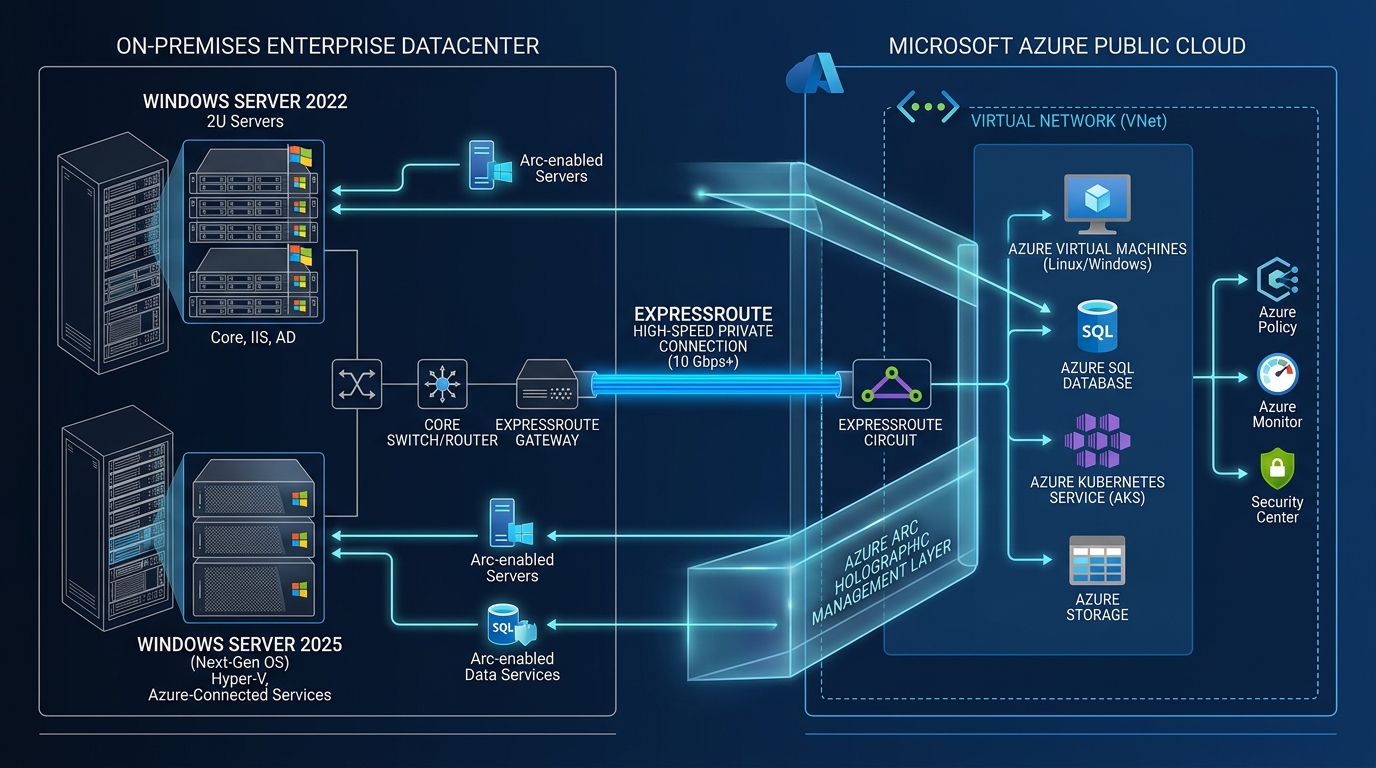
- Azure Arc-Enabled Servers: Projecting bare-metal on-premises Windows Server 2022/2025 instances into the Azure Resource Manager (ARM) control plane.
- Windows Admin Center: Browser-based management gateway integrating Azure File Sync, Azure Backup, and Azure Network Adapter.
</div> <div> --tenant-id $TenantId </div> <div> --resource-group $ResourceGroup
- Deep Dive: Configuring Windows Server Hybrid Advanced Services (Exam AZ-801)
Exam AZ-801 tests enterprise-scale resilience, high availability, threat protection, and automated disaster recovery. Candidates must demonstrate deep technical mastery across advanced hybrid scenarios:
High Availability & Clustering
Configure Failover Clustering with Cloud Witness in Azure Blob Storage. Implement Storage Spaces Direct (S2D) hyper-converged infrastructure (HCI) with NVMe caching tiers, and manage Cluster Shared Volumes (CSV) with zero single points of failure.
Disaster Recovery (ASR)
Orchestrate business continuity using Azure Site Recovery (ASR) for continuous asynchronous replication of Hyper-V VMs to Azure IaaS disks. Perform automated test failovers without impacting production host networks.
Enterprise Threat Hardening
Protect domain controllers against pass-the-hash attacks using Credential Guard (Virtualization-Based Security). Enforce automated patch baselines using Azure Update Manager, and stream security audit logs directly into Microsoft Sentinel SIEM.
- The Cloud Architect Pinnacle: Azure Administrator (AZ-104) & Solutions Architect Expert (AZ-305)
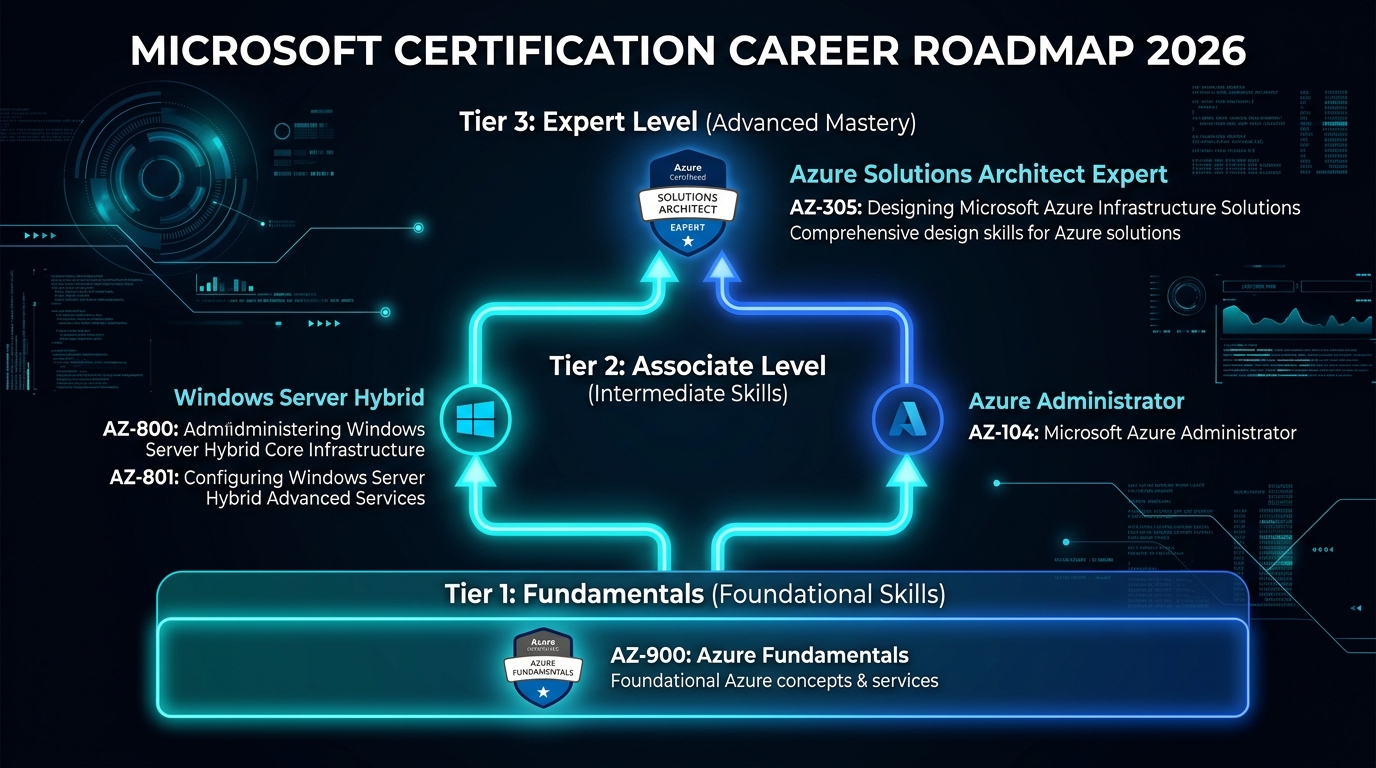
For engineers looking to transition beyond day-to-day server administration into enterprise cloud architecture, the combination of Exam AZ-104 (Azure Administrator) and Exam AZ-305 (Designing Microsoft Azure Infrastructure Solutions) constitutes the true spiritual successor to the MCSE Core Infrastructure credential:
The Microsoft Azure Well-Architected Framework (WAF)
The AZ-305 examination evaluates whether an architect can design scalable, cost-efficient, and highly available architectures across the five core WAF pillars:
- 2026 Modern MCSE Credential Matrix & Enterprise Compensation Benchmarks
This comprehensive matrix outlines the current certification tracks, official prerequisite exams, primary target engineering roles, and global salary expectations across North American, European, and Gulf IT markets:
| Credential Level | Required Exams | Primary Technical Domain | Target Enterprise Job Title | Global Salary Benchmark (2026) |
|---|---|---|---|---|
| Associate Level Windows Server Hybrid Administrator | AZ-800 + AZ-801 | Windows Server 2022/2025, Active Directory, Azure Arc, Hyper-V, Storage Spaces Direct, ASR | Senior Systems Administrator / Hybrid Infrastructure Engineer | $95,000 – $130,000/yr (AED 16,000 – 24,000/mo) |
| Associate Level Microsoft Certified: Azure Administrator | AZ-104 | Azure Compute, Virtual Networks, Blob Storage, Entra ID Governance, Azure Monitor, ARM Templates | Enterprise Cloud Administrator / Azure Systems Engineer | $105,000 – $140,000/yr (AED 18,000 – 26,000/mo) |
| Expert Level Microsoft Certified: Azure Solutions Architect | AZ-104 (Prereq) + AZ-305 | Enterprise Architecture Design, High Availability, Disaster Recovery, Microservices, Zero-Trust WAF Governance | Principal Cloud Architect / Enterprise Infrastructure Lead | $145,000 – $195,000+/yr (AED 28,000 – 42,000+/mo) |
To ensure state-of-the-art visual presentation, the diagrams and cover imagery featured in this technical blueprint adhere to the following generative design prompts:
Cover Thumbnail (16:9): High-end 3D isometric enterprise datacenter with glowing cyan and blue fiber-optic conduits, holographic Microsoft Azure cloud nodes floating above, modern Windows Server rack cabinets, clean hyper-converged tech aesthetic, 8k resolution, cinematic lighting, sleek corporate IT infrastructure without text.
In-Article Diagram 1 (Hybrid Architecture): Architectural technical visualization of an enterprise hybrid cloud network: left side shows an on-premises enterprise datacenter with Windows Server 2022 and 2025 rack servers, connected via glowing blue high-speed ExpressRoute fiber optic bridge to a right-side glowing Microsoft Azure cloud infrastructure with Azure Arc holographic management layer.
In-Article Diagram 2 (Roadmap Hierarchy): Clean modern enterprise infographic showing Microsoft certification career roadmap in 2026: Tier 1 at bottom shows Azure Fundamentals (AZ-900), Tier 2 shows Associate Level (Windows Server Hybrid AZ-800 AZ-801, Azure Administrator AZ-104), Tier 3 at top shows Expert Level (Azure Solutions Architect Expert AZ-305).
Frequently Asked Questions: Modern MCSE & Microsoft Hybrid Certifications
- Is the legacy MCSE (Microsoft Certified Solutions Expert) certification still valid?
If you earned a legacy MCSA or MCSE credential before its official retirement, it remains permanently on your official Microsoft transcript under the “Legacy” or “Historical” section and does not expire. However, it is no longer actively evaluated or updated by Microsoft. Modern enterprise employers screening candidates for 2026 infrastructure roles prioritize current role-based credentials such as the Windows Server Hybrid Administrator Associate (AZ-800/AZ-801) and Azure Administrator (AZ-104).
- Should a Windows Server engineer take Exam AZ-800/AZ-801 or Exam AZ-104 first?
If your daily responsibilities involve on-premises Windows Server operating systems, Active Directory Domain Services, Hyper-V clusters, and group policies transitioning toward Azure, begin with the Windows Server Hybrid Administrator Associate (AZ-800 & AZ-801) track. If your objective is purely cloud-native infrastructure, software-defined networking, and Azure resource governance without managing on-premises bare-metal servers, prioritize Exam AZ-104 (Azure Administrator).
- What is the difference between Exam AZ-800 and Exam AZ-801?
Both exams are required to achieve the Windows Server Hybrid Administrator Associate certification. Exam AZ-800 covers core operational services: identity (AD DS and Entra ID), networking (DNS, IPAM, hybrid routing), and compute management in hybrid environments. Exam AZ-801 covers advanced services: high availability (Failover Clustering, Storage Spaces Direct), disaster recovery (Azure Site Recovery), migration (Storage Migration Service, Azure Migrate), and security hardening (Credential Guard, Defender for Cloud).
- How difficult is the transition from legacy Active Directory to Microsoft Entra ID?
The conceptual transition requires shifting from traditional Kerberos/NTLM ticket-based authentication, LDAP queries, and organizational unit (OU) Group Policies to modern claims-based authentication (OAuth 2.0, OpenID Connect, SAML) and Conditional Access policies. By leveraging Microsoft Entra Connect Cloud Sync and Hybrid Azure AD Join, organizations achieve a non-disruptive, unified identity bridge.
- What hands-on laboratory environment is recommended to pass AZ-800 and AZ-801?
A recommended hybrid lab comprises a physical workstation or local virtualization host (with 32GB–64GB RAM) running Hyper-V with at least two Windows Server 2022/2025 domain controllers, connected to a free Azure trial subscription via an Azure Site-to-Site VPN or Windows Admin Center Network Adapter. Practice configuring Entra Connect Cloud Sync, onboarding virtual machines to Azure Arc, configuring Storage Spaces Direct pools, and simulating Hyper-V VM replication using Azure Site Recovery.